

What’s the context?
The world faces an existential crisis of a rapidly heating climate and, in reality, the status quo and the policies currently in place are unlikely to be sufficient to fix it.
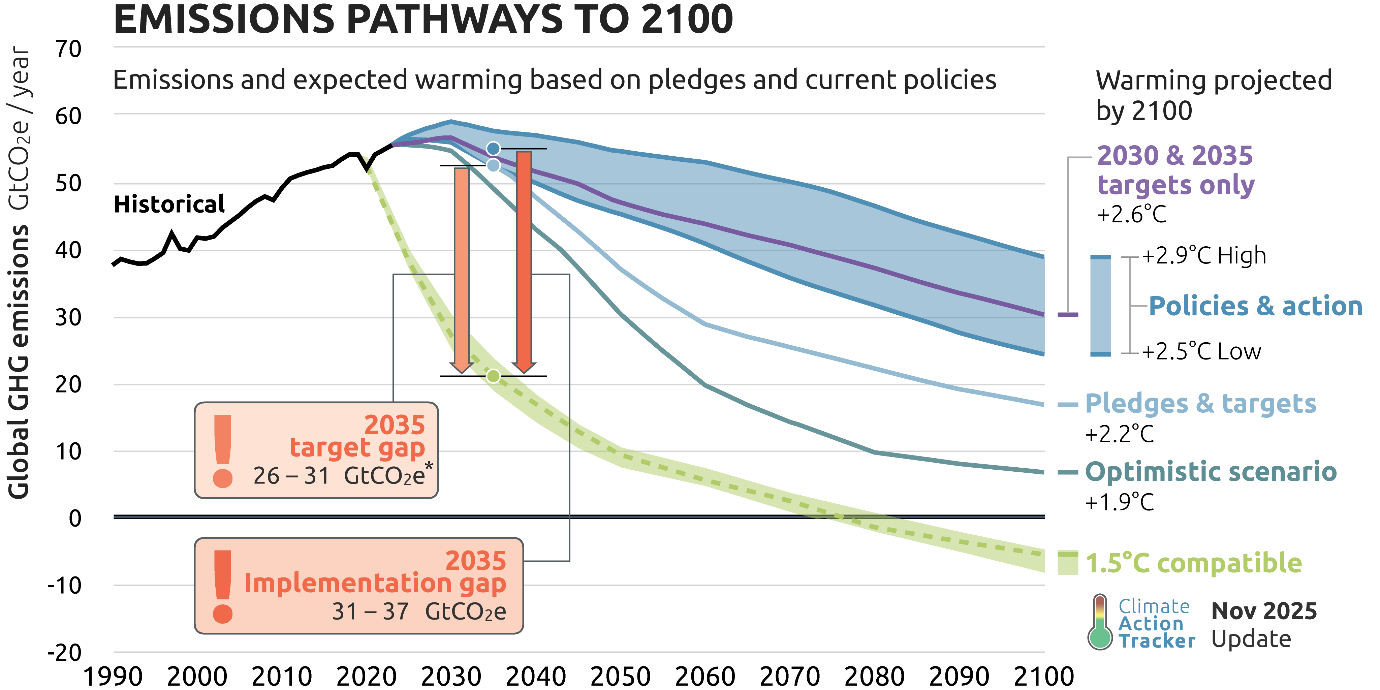
The Climate Action Tracker project tracks government climate action and measures it against the globally agreed Paris Agreement aim of “holding warming well below 2°C, and pursuing efforts to limit warming to 1.5°C”. Its projections show that with the rate of greenhouse gas (GHG) emissions currently being produced and the policies in place around the world to limit them we are still projected to hit about 2.9°C of warming above pre-industrial levels by the end of the century – nearly double the Paris Agreement goal.
2024 was confirmed by the Copernicus Climate Change Service to be the warmest year on record globally (with 2025 ranked as the third-warmest year). It was also the first calendar year that the average global temperature exceeded 1.5°C above the 1850-1900 pre-industrial average.
At a macro level, this is a source of financial risk and opportunity. For example, in October 2024, the Organisation for Economic Cooperation and Development stated that estimated global climate mitigation and adaptation finance needs are between USD 5.9 and 12 trillion annually until 2030. And the US National Bureau of Economic Research published a paper in May 2024 concluding that macroeconomic damage from climate change would be up to six times higher than previously thought, with each 1°C of warming reducing world GDP by 12%.
What are my compliance obligations?
As trustees can take into account things that are financially material then, if fossil fuels are to be phased out, trustees can take account of that fact as a financial risk.
Likewise, if renewables are the best prospect for the future and there’s a need to finance them, then trustees can invest in them should they deliver suitable returns.
The problem with this approach is that leaving such decisions in the hands of trustees may not bring about the macro-level changes required for the UK Government to meet its policy aims or reorientate the capital flows necessary to meet the goal of the Paris Agreement.
For more on what fiduciary duties require of pension trustees, see Fiduciary duties explained

The Government could, in theory, legislate as it sees see fit if it wishes to change the position. Its 2025 consultation on transition plans may put this into sharper focus.
Higher global temperatures and more extreme weather events pose physical risks to assets. But perhaps of even greater significance to investors is the market impact of the required transition to a net zero economy. As the Climate Action Tracker chart above shows, keeping temperature rises to those aspired to in Paris will require a fundamental shift in how all businesses and society operate.
For an investor, some businesses invested in may be well positioned for this transition and some will not.
Systemic risk
Climate risks are generally divided into physical risks, such as prolonged heat waves, drought and rising sea-levels, and transition risks – essentially risks to company business models from de-carbonising the economy.
It’s now generally understood by asset owners that these can create financially material risks and opportunities for investment portfolios. But there are wider implications to consider. Both physical and transition risks can affect financial institutions through, for example, increases in claims paid by insurers, or decreases in the creditworthiness of borrowers and liability arising from litigation or regulatory change or intervention.
These shocks can pose a systemic threat to the financial stability of entire markets, if they occur at the same time. This systemic risk can level down whole portfolios for asset owners and cannot easily be diversified away from.
To what extent can trustees consider and act on market-wide issues? It may be challenging for trustees to demonstrate the causal link between their investment decisions and the wider economic benefits delivered, even less the overall advantage that such wider economic benefits might then revisit on a scheme’s overall portfolio. But if everyone thinks like this then these wider economic benefits are never delivered to anyone, because each individual set of trustees consider themselves too small, and their own asset-owner clout too insubstantial, to make a difference.
The prisoner’s dilemma
The systemic risk of climate change manifests for trustees in a similar way as in the prisoner’s dilemma, a game theory concept. Two bank robbers are being interrogated separately, with neither able to know whether his accomplice will testify against the other. Both robbers can minimise their collective jail time only if they cooperate and stay silent. But without knowing what the other is going to do, the incentives that they each face separately drive them to testify against each other. The result is that they will collectively end up doing the maximum combined jail time.
For trustees, the incentives faced by each individual trustee board (and based on a conventional legal analysis of fiduciary duty) might induce them to invest only so far as it can be established that an investee company can “do well financially by doing good”. But this alone may not be nearly enough to address the systemic risks we face. Acting cooperatively, however, could make investors collectively better off by pursuing a strategy that offers the wider economy the best chance of success.
What are the latest developments?
Some of the more progressive trustees are starting to respond to this in their investment strategies. But the reality as things stand is that only the very largest schemes will feel confident to act to deliver broader benefits to the economy – in a belief that the indirect benefits delivered to the scheme and its beneficiaries will not be “too remote and insubstantial”.
See Transition plans for details on the Government’s consultation on transition plans.